Weathering the Winter, Singing for Spring

This winter has been one for the record books. With more snow than we have had in years and long bouts of bitter cold temperatures, we Minnesotans have been weathering the many different winter storms and unprecedented cold. We survived the cruel visit from the polar vortex, are shoveling ourselves out of winter storm Nika, and have our sights set on spring. We are not alone in our tribulations. Throughout winter a cold hearty, feathery friend has been keeping us company, pulling through the winter, and now signaling that spring will actually arrive.

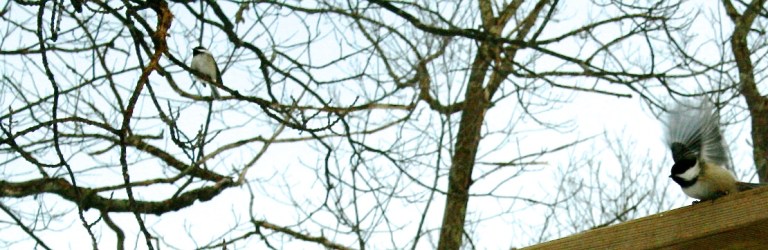
The Black-Capped Chickadee weathers winter as well as any tough Northerner. A small and common songbird, weighing only about 10 grams, stays up and active throughout the winter season. The chickadee is a curious songbird interested in learning all it can about its territory, even the human inhabitants. Thus, a chickadee is a common bird to see at feeders, and is easily identified by its small rotund shape, distinct black cap, and various songs. Even in the blustering cold and snow, the chickadee is commonly seen visiting the feeder and flying with the flock.The chickadee possesses a few great tools to make it through a tough winter; from staying warm, to finding friends.

Winter Survival Guide, Black-Capped Chickadee Edition:

1. Expand your Brain. Literally. Every fall the chickadee expands the part of its brain responsible for spatial memory (the hippocampus). By increasing the brain capacity by 30% the chickadee can work to gather and store food for the winter, then recall where dinner is on the worst winter day.

2. Insulate. A chickadee’s spherical shape is mostly feathers. A thick down layer covers a tiny body to insulate in the cold winter months.

3. Just keep eating. In the winter, chickadees eat enough seeds and berries to put on 10% of their body weight in one day, and in one night it is all burned off.

4. Get a little help from your friends. A chickadee flock uses multiple calls and songs to communicate with one another, and in the winter often associates with other bird species, such as; nuthatches, woodpeckers, kinglets, creepers, warblers and vireos.

The chickadee has survived the majority of winter and has its sight set on warmer days, more food, and mating season – oh the wonders of spring. As daylight increases, so do their songs; raising our hopes for the end of this relentless winter. When the sun shines again, listen for the “SPRING time” call of the chickadee. As the frequency of the song increases, the days of winter dwindle down, signaling to us that spring is truly not too far away.
The Upside of Cross Country Skiing

Recently, I transformed from a cross country ski novice, skiing one or twice in my life, to being a ski instructor.

At my current job, naturalists (teachers at the conservation center) teach fifth and sixth graders a variety of programs in environmental education, conservation practices, and outdoor recreation. So, one week I was scheduled to attend an instructor training in cross country skiing, and three days later, I was strapping on a pair of skis with 20 or so students and hitting the trails. And it went well…down…then down again, falling, slipping, loosing my footing…down, down, down. I counted 7 falls in that class; a student reassured me that he fell 21 times exactly, so I was doing “pretty good”. However, I wasn’t quite consoled. I thought I was going to be swift, strong, a perfect example for the kids. Turns out my inability to ski, or stay upright on my skis, was an unseen teaching moment for me. One, I had to show the kids how to fall and how to get up (demonstrated multiple times). Two, my class of novices and I figured out together what made skiing easier, faster, smoother, and less painful. Students who already got the hang of skiing, demonstrated some helpful techniques. In no time we were gliding on the trails with only minimal falling.

After some practice and quick lessons from students and co-workers, I am finally feeling confident on the cross country ski trail. For the most part, traditional cross country skiing is just as they say “a push and a glide” and as easy as walking (once you learn how). The learning process took about three good practice runs, but was worth the sore backside. Today, I skied for about 5 miles around Long Lake, and everything about the ski trek was favorable:

1. It didn’t matter if it was -20 degrees and snowing. Skiing is a full-body, aerobic workout and even in this MN cold it is possible to stay warm! Again, a FULL BODY WORKOUT and all I had to do was step onto the trail. Cross country skiing,  practiced with ample speed and good distance, can burn more calories than any other sport!

2. Skiing allowed me to travel miles in snowy conditions in a relatively short amount of time. If I had set out on  a hike to get my nature fix, I would still be out in the woods trudging through snow 6 hours later. On the ski trail I got in some birding (Pileated Woodpecker, Downy Woodpecker, Hairy Woodpecker, and heard the sounds of a Barred Owl), observed a dozen different tracks  traveling the snowy forest floor, and even had time to take some pictures.

The benefits of cross country are just astounding. I was excessively happy with my nature filled full body workout, and even a little bit proud of my newly honed skiing ability. With practice under my belt, plans to practice skiing often, and all this excitement about a newfound hobby- I cannot wait to get back out on trails with students and teach with a discovered positivity for cross country skiing. I know I will still slip up and fall; but now instead of failure, a fall means a short rest and better view of the birds in the tree tops

Falling is A okay!

Falling is A okay!

.